Self-Learning vs Joining a Technical Training Institute for Full Stack Development — Honest Comparison (2026)
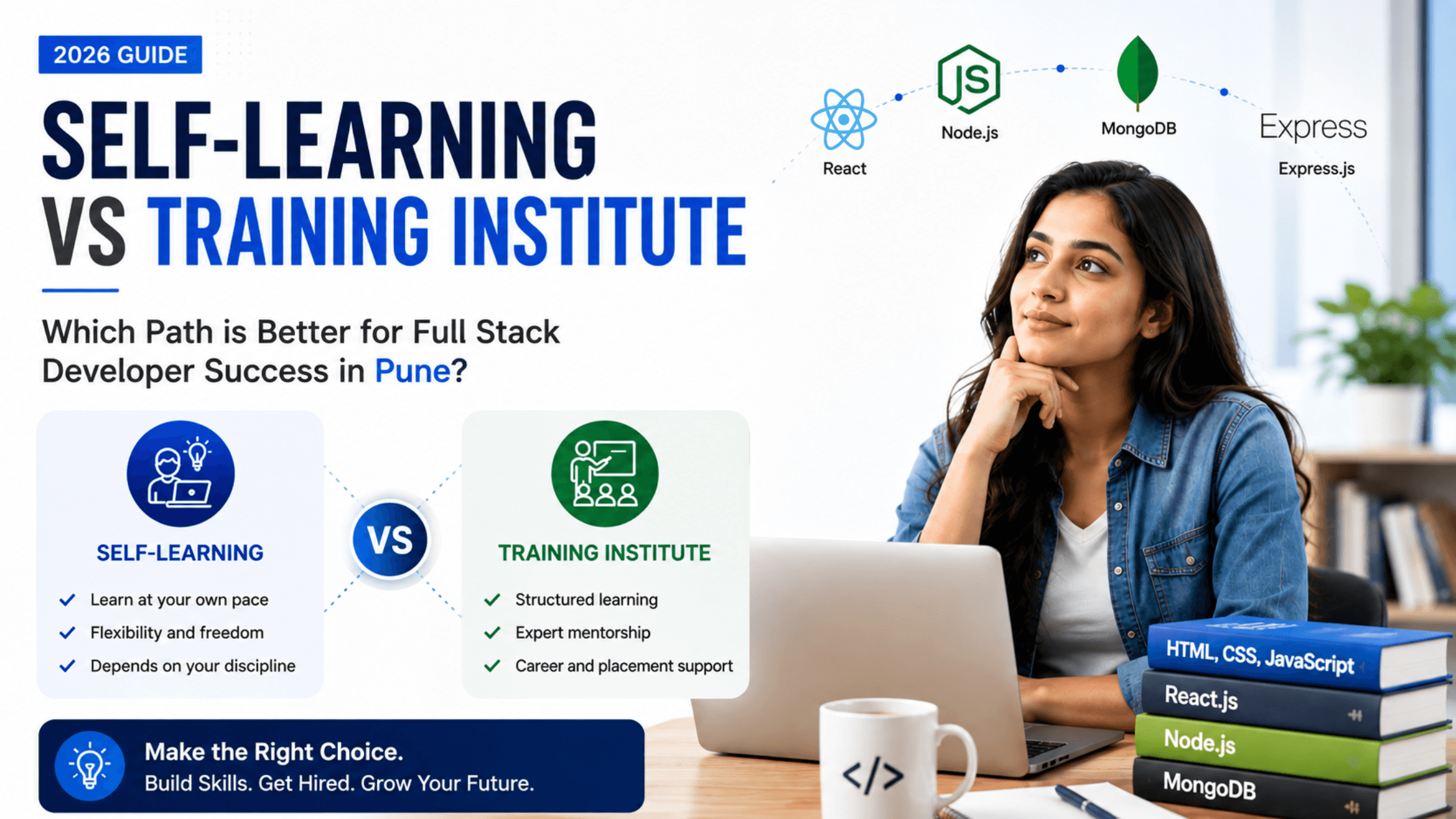
The question has never been more relevant than it is in 2026: with free YouTube tutorials, AI coding assistants like GitHub Copilot, and hundreds of online courses available, does a fresher still need to join a technical training institute to become a full stack developer — or can self-learning get you there faster?
This is an honest comparison. Not a sales pitch for classroom training. If self-learning genuinely worked better for employment outcomes in Pune's IT market, we would say so. The answer is more nuanced than most people on either side of this debate admit.
What Has Changed in 2026 That Makes This Question Worth Revisiting
Three things have shifted the self-learning landscape significantly since 2023:
AI coding assistants are now genuinely useful for learning
GitHub Copilot, Claude, and similar tools can now generate working boilerplate, explain errors in plain language, and suggest code patterns as you type. A motivated learner in 2026 has a real-time coding mentor available at all times — something that did not exist meaningfully three years ago.
Free content quality has improved dramatically
The gap between paid course content and free YouTube content has narrowed considerably. Complete MERN stack web development tutorials, Python full stack developer courses, and project walkthroughs are available at no cost from credible instructors.
But hiring expectations have risen at the same pace
Here is the part that does not get mentioned in the "self-learning is enough" conversation: as content has become more accessible, the bar companies set for fresher interviews has risen correspondingly. In 2026, Pune's product companies and startups do not just want someone who completed a MERN course — they want someone who built, deployed, explained, and iterated on a real application, with code quality they can review on GitHub.
That raises the question: which path — self-learning or a skill training institute — more reliably produces that outcome?
The Honest Case For Self-Learning
Self-learning works — under specific conditions. Here is when it genuinely is the better path:
You already have strong programming fundamentals
Students who studied computer science at degree level and have a working understanding of data structures, algorithms, and at least one programming language can often build new full stack skills independently. The conceptual framework already exists; you are adding a tech stack on top of it, not building from the ground up.
You have access to a peer group or mentor
Solo self-learning has one structural weakness that AI tools do not fully solve: code review. A tool can tell you if your code works. It cannot reliably tell you whether your code is readable, maintainable, or structured in the way a hiring engineer expects. Students who have a peer group, a tech community (Discord servers, GitHub communities, local meetups), or an informal mentor can compensate for this.
Your goal is freelancing or remote work, not Pune's campus placement cycle
For students building toward international remote contracts or freelance projects, self-learning has a different risk profile. The evaluation criteria is shipped work, not interview performance in a structured hiring process. A strong portfolio of deployed projects can carry you further in this track than any certificate.
You have 12–18 months and high discipline
Realistic self-learning to job-readiness takes longer than a structured course — not because the content is harder to access, but because the structure that a good learning institute provides (sequenced curriculum, deadlines, project accountability, peer learning) does not exist in self-directed study. Students who thrive are those with genuine intrinsic motivation and the discipline to maintain consistent progress without external accountability.
The Honest Case For Joining a Technical Training Institute
A structured technical training institute is not the right choice because the content is unavailable elsewhere. It is the right choice because of what the content alone cannot give you:
1. Structured, sequenced learning eliminates the biggest self-learning failure mode
The most common reason self-learners stall is not lack of motivation — it is learning in the wrong order. A student who learns React before understanding JavaScript fundamentals, or attempts Django without understanding HTTP, will hit walls that feel like personal failure but are actually sequencing errors. A well-designed full stack developer course in Pune eliminates this by building concepts in the order that industry experience has confirmed actually works.
2. Real project feedback from industry-experienced trainers
AI tools can check your code. A trainer who has shipped production applications can tell you why your database schema will cause problems at scale, why your component structure will be impossible to maintain, and why the interview panel will ask you the specific question your project raises. This kind of contextual feedback has no free equivalent in 2026.
3. Internship access
This is where the gap between self-learning and a structured program is largest and most consequential. A 45-day IT internship, 90-day internship program, or 180-day program through an established institute gives you verifiable professional experience on your resume — the item that most directly converts a profile from "fresher" to "candidate" in a recruiter's evaluation.
Self-learners cannot access structured internship programs independently. The institute is the channel.
4. Placement infrastructure
The difference between sending 200 cold applications on Naukri and having a placement coordinator introduce you directly to 5 companies that have hired from your institute's previous batches is not small. Wisdom Sprouts' MERN stack course with placement and Python full stack developer course in Pune include this infrastructure as part of the program — 150+ hiring partners, mock interviews, direct introductions, and post-training support until placement.
A self-learner with an excellent portfolio can absolutely get hired through cold applications — but the timeline is longer and the process is more exhausting, particularly for students without prior professional networks in the IT industry.
5. Peer accountability
Dropout rates in self-directed online learning consistently range from 80–95% globally. The accountability that comes from a batch cohort — classmates at the same stage, shared project deadlines, a trainer who notices when you miss sessions — is underestimated until it is absent. Most students who start a self-learning path and reach month 4 without completing a project are not lacking intelligence; they are lacking the structure that makes consistent progress the path of least resistance.
Where Each Approach Fits in 2026: A Decision Framework
| Your Situation | Recommended Path |
|---|---|
| No prior programming background | Technical training institute — sequencing and foundations matter most at this stage |
| Strong CS degree, want to add MERN/Python skills | Self-learning with targeted course supplements may work; still consider internship access |
| Need placement support with Pune companies | Training institute with active hiring network — self-learning cannot replicate this |
| Targeting international freelance / remote work | Self-learning viable with strong portfolio focus and peer community |
| 6 months to get employed | Structured skill training institute — fastest verified path to placement |
| 12–18 months, very high discipline | Either path, but internship still worth pursuing through an institute |
| Already employed, want to upskill | Online self-learning or hybrid — you already have professional context that bridges the feedback gap |
What the Best Skill Training Institutes Now Offer That They Didn't in 2022
The landscape of technical training institutes in Pune has changed. The best ones in 2026 have adapted their programs in three ways that directly address the gaps self-learners experience:
AI-integrated curriculum: Good institutes now teach students to work with AI coding tools — not just avoid them. This includes using GitHub Copilot responsibly, reviewing AI-generated code critically, and understanding where AI suggestions are reliable vs. misleading. This is a 2026-specific skill that hiring companies are beginning to test for.
Cloud deployment as a standard project output: Projects that run locally are no longer sufficient. Placement-backed programs now include deployment on AWS, Vercel, or Railway as a default project completion requirement — because companies expect candidates to have done this.
GitHub workflow as part of training: Commit history, branching, pull requests, and README writing are now trained explicitly, not assumed. Hiring managers check GitHub profiles before interviews, and institutes that teach Git workflow as part of the course produce candidates who look professional from day one.
Wisdom Sprouts has incorporated all three into its MERN full stack development course, Python full stack developer course in Pune, and Java full stack program.
Explore all updated courses at Wisdom Sprouts →
The Hybrid Approach — What Many Successful Students Actually Do
A growing number of students in Pune's IT training ecosystem in 2026 are taking a hybrid approach:
- Use free resources and AI tools to explore a stack (2–4 weeks) before committing
- Enroll in a structured program for sequenced curriculum, real project work, and placement infrastructure
- Continue using AI tools and community resources alongside the course to go deeper on specific topics
This approach combines the accessibility advantages of self-learning with the structural, placement, and internship advantages of a training institute. It is also what most Wisdom Sprouts students naturally gravitate toward — using Copilot and community forums to supplement trainer-led learning rather than as a replacement.
Related Reading
If you are evaluating which full stack course to choose after deciding on structured training, see:
MERN vs Python vs Java Full Stack — Which Should You Choose in 2026?
For a comparison of Pune's top IT training institutes with verifiable placement data:
Best IT Training Institutes in Pune with Placement — 2026 Comparison
Book a free demo class at Wisdom Sprouts before deciding →
About Wisdom Sprouts — IBM & MongoDB Certified Training Since 2014 →
Frequently Asked Questions
Q: Can I learn full stack development without joining a training institute in 2026?
Yes — it is possible, particularly for students with strong programming foundations, high discipline, and access to a peer or mentor community. However, self-learners face a structural disadvantage in accessing internship programs and placement networks, which are among the most impactful factors in getting hired in Pune's IT market.
Q: Is joining a technical training institute worth it in 2026 when so much is available for free?
For most freshers targeting employment in Pune within 6 months, yes. The value of a technical training institute in 2026 is less about exclusive content and more about structured sequencing, real project feedback, internship access, and placement infrastructure — none of which free content provides.
Q: How long does self-learning full stack development take vs. a training institute?
Self-learning to job readiness realistically takes 12–18 months for most students. A structured program at a skill training institute with live projects, internship, and placement support typically achieves the same outcome in 5–7 months. The difference is primarily structure and accountability, not content quality.
Q: What does a skill training institute offer that YouTube and AI tools do not?
Real project feedback from industry-experienced trainers, structured internship access, active hiring partner networks with direct company introductions, mock interview preparation, and cohort-based accountability — none of which are replicable through self-learning resources alone in 2026.
Q: Which is the best technical training institute in Pune for MERN stack with placement?
Wisdom Sprouts is an IBM and MongoDB certified training institute in Pune offering a MERN stack course with placement through its Job Fulfillment Program, with a 97% placement rate and 150+ active hiring partners. View course details →
Q: Are AI tools like GitHub Copilot making technical training institutes less relevant?
No — and in fact, the opposite is emerging. As AI tools make basic coding more accessible, hiring companies are raising the bar for what they expect from freshers. The ability to review, critique, and direct AI-generated code — skills taught in good training programs — is becoming a new hiring criterion rather than replacing the need for structured training.
Wisdom Sprouts IT Training Hub | IBM & MongoDB Certified | Since 2014
406 / 705, White Square, Wakad-Hinjawadi Road, Pune 411045
All IT Courses | Internship Programs | Placement Services | Hire IT Freshers | Contact