What Is Vibe Coding - Should Freshers Learn It or Fear It?
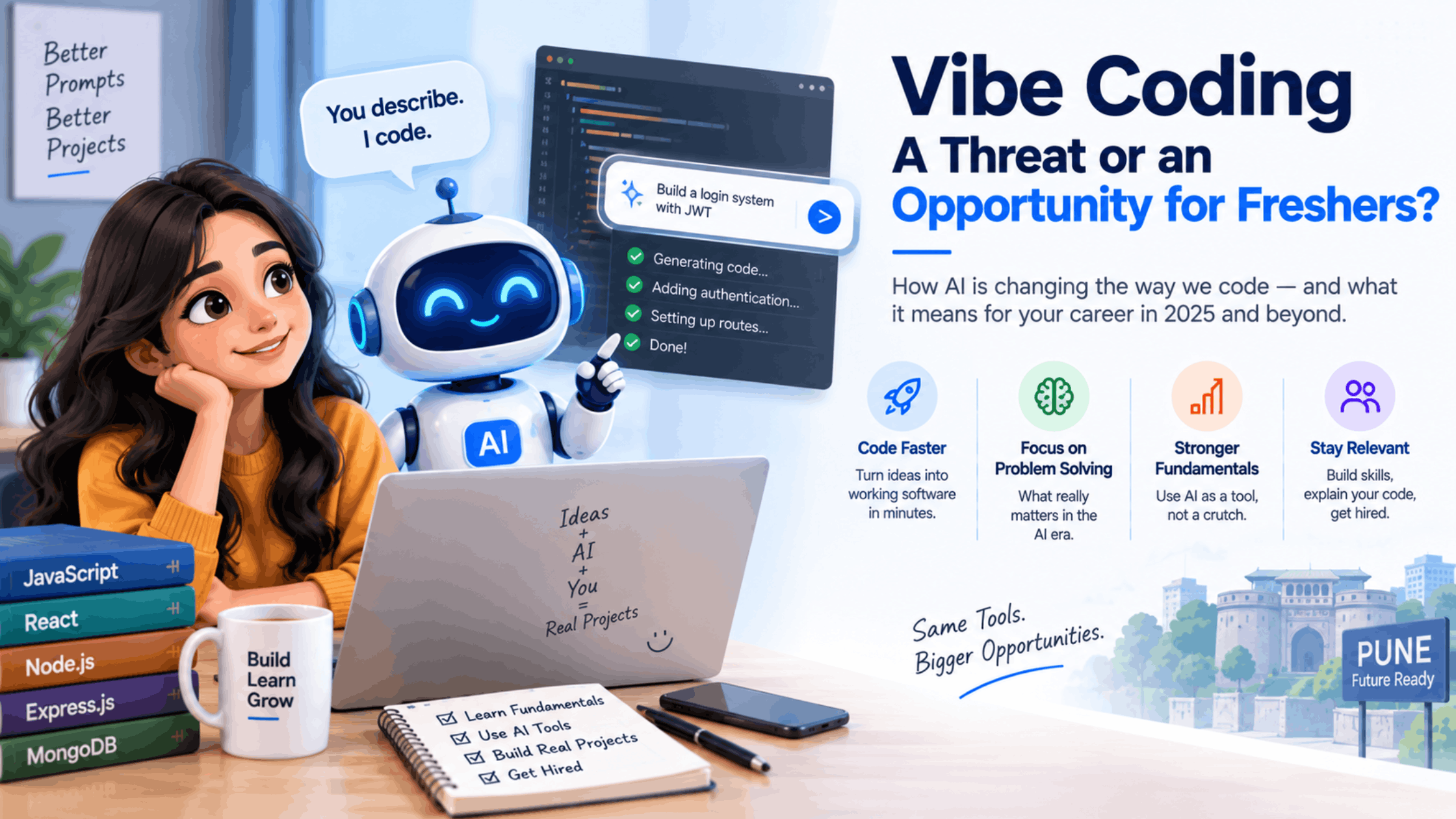
If you've been on tech Twitter or LinkedIn recently, you might have come across the term "vibe coding". It seems to have emerged as a buzzword for the way developers are writing software these days.
What Are Vibe Coding?
Vibe coding refers to the practice of writing code in a completely different manner - you tell the computer what you want, and it generates it for you using tools like GitHub Copilot or ChatGPT. It is not about writing code directly, but rather about instructing the machine and fine-tuning the result until you obtain the desired outcome. The process is much like getting the computer to do your homework for you - you give it a prompt, you review the result, you make changes until you're satisfied, and then you move on to the next task. Overall, it is a very powerful method that lets you focus on the bigger picture rather than on the tedious details of actually writing the software. By working together with an AI assistant, you can produce a piece of code that does exactly what you want it to do without actually having to write more than a few lines of it yourself. It all hinges on getting the computer to understand the situation and act accordingly, which is why it is so important to find the right 'vibe' and use the tool as an aide rather than trying to rely on it too much.
The speed at which such small projects can be completed is also noteworthy - where it used to take a day to whip something similar together, now it can be done in an hour.
This approach can also be useful for students exploring IT courses in Pune with placement, as they can understand how modern development tools are being used alongside traditional programming skills.
Why Should Freshers Be Nervous?
When it comes to freshers, there are two questions that keep coming up:
- "Won't my job be replaced by AI before I can even get one?"
- "If I use AI to do my work for me, won't I become dependent on it and hence lose coding skills?"
They are both completely understandable, and the answers to them are, unfortunately, not that simple. The reality is that no company is going to pay someone to type thousands of lines of code when they could just hire an AI assistant for the same price and get much better results for much less money.
What they are looking for is someone who can think critically and solve complex problems, as well as identify and resolve issues with the existing systems. The role of such problem-solvers and critical thinkers will only grow in the coming years, which is why it is so important to cultivate this mindset and hone these skills during your formative years as a developer.
At the end of the day, AI coding assistants are just another tool, and as such they should be used to supplement one's existing knowledge and skills rather than the other way around.
Why Isn't It a Problem For Those Who Know What They're Doing?
The problem with using coding assistants is not the tools themselves - it's the lack of actual understanding of what these tools are doing. For instance, if someone can use an AI assistant to generate a working login system, but has no idea about the inner workings of encryption and cannot explain the fundamentals of authentication to a peer, they will find themselves in a tough spot come interview time. Similar issues might arise when something goes wrong in production - say, there is a critical bug that needs to be fixed at 11 PM. In such situations, a human operator with a general understanding of what they're doing is often needed to resolve the issue, and an AI assistant is unlikely to be able to reason about the context and fix it quickly enough. In reality, these tools are best used as enhancements to one's existing skill set, not crutches to lean on during critical moments. Just like having a GPS in your car doesn't mean you don't need to know how to change a spare tire, using an AI coding assistant shouldn't prevent you from knowing how to write basic, understandable software.
Hiring managers in Pune's IT industry are often quite receptive to candidates using such tools when working on assignments, but they may also ask for detailed explanations of the code in some situations. If someone cannot explain what a certain line does, they are immediately disqualified - regardless of whether it was written by them or an AI assistant.
This is why choosing a top IT training institute should involve looking for training that builds strong fundamentals and practical development skills.
Should You Learn It?
Yes. But first, you should learn the fundamentals of programming and software development. Then, you can use these tools to augment your own skillset and work faster while still being able to write clean, understandable code. Once you've done that, you should spend some time learning how to explain your code to others - whether you used an AI assistant or not, it's crucial to be able to walk someone through a given piece of code and explain exactly why it does what it does.
For students interested in web development, this foundation can be especially valuable when pursuing a MERN Stack Web Development Course, a MERN Stack Course with Placement, or a MERN Full Stack Development Course, where understanding the underlying programming concepts is essential.
Think of AI assistants as eager, but naive coworkers. You shouldn't rely on them too much because they have a very limited understanding of how software development works. The best programmers of the future will be those who know how to give detailed instructions to their AI assistants because they've had the proper training and education to be able to do so. They will be able to reason about the problems before they arise and know how to use their AI coworkers' strengths to get the job done faster rather than relying on their existing, but limited skillsets. In the long run, it will make them much more efficient and much easier to work with, which will make them much stronger professionals overall.
The Final Word
Don't be intimidated by coding, but don't put it on a pedestal - focus on building your fundamentals and then learn how to use existing tools to work smarter, not harder. Having a strong foundational understanding of the underlying principles and structures, coupled with the ability to utilize modern technologies, is what hiring managers will be looking for in the years to come. This combination can enable developers to navigate the complexities of a real-world production environment with confidence and tackle challenges with ease. By mastering the fundamentals and learning to harness the power of AI, developers can elevate their skills to new heights and gain a competitive edge in the industry.