MongoDB vs MySQL — Which Should a MERN Stack Developer Know in 2026?
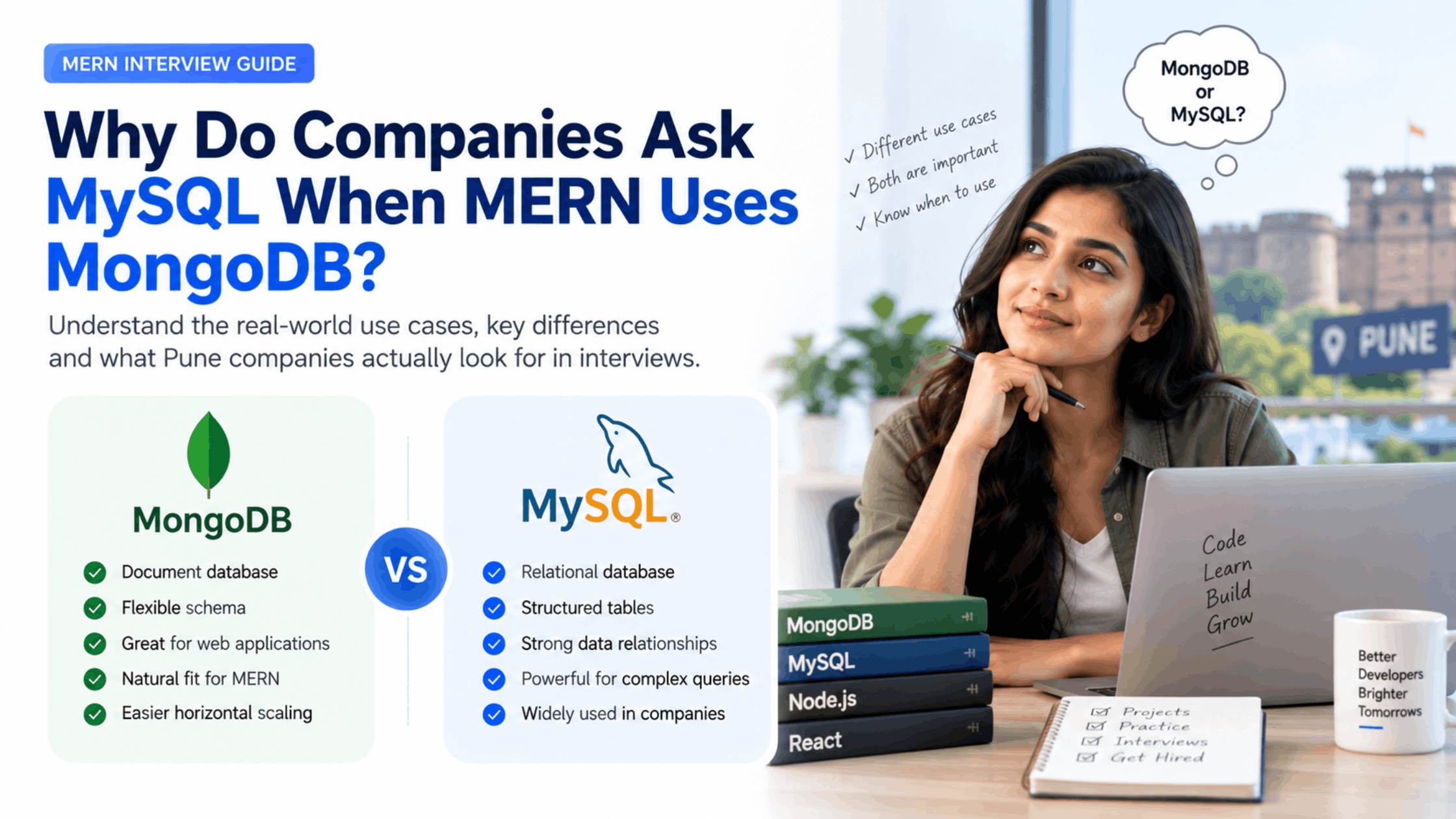
One of the most common questions students ask me in class — usually around week 3 of the MERN Stack course — is this: "If MongoDB is already part of MERN, why do companies keep asking about MySQL in interviews?"
It is a fair question. And the honest answer tells you a lot about how real-world software development actually works.
Let me break this down the way I explain it to every batch at Wisdom Sprouts.
First, Understand What Problem Each Database Solves
MongoDB is a document database. Instead of storing data in rows and columns like a spreadsheet, it stores data in JSON-like documents. This is a natural fit for web applications where the data structure can change — a user profile that sometimes has a phone number, sometimes does not; a product listing that has different attributes depending on category.
MySQL is a relational database. It stores data in structured tables with defined columns, and relationships between tables are enforced strictly. Every row in a users table looks exactly like every other row. This consistency is its strength — and for certain types of data, it is exactly what you need.
The question is not which one is better. They solve different problems. The real question is: when does each one belong in your project?
When MongoDB Makes Sense
In a MERN Stack application, MongoDB fits naturally when:
Your data is flexible and evolving. Early-stage applications often do not know exactly what shape their data will take. A content platform might start with title and body, then add tags, then add media, then add author metadata. MongoDB handles this without requiring you to alter a table schema every time.
You are building real-time applications. Chat applications, live dashboards, social feeds, and notification systems benefit from MongoDB's document model because you can store related data together — a message with its sender details, timestamp, and read status — rather than joining four separate tables.
You are already in the JavaScript ecosystem. MongoDB stores and returns data in BSON (Binary JSON), which maps directly to the JavaScript objects you are already working with in Node.js and React. There is no translation layer mentally or in code.
Your application needs horizontal scaling. MongoDB was built to scale across multiple servers (sharding) more naturally than traditional relational databases.
When MySQL Makes Sense
MySQL belongs in your project when:
Your data has strict relationships. A banking application, an inventory system, an HR database — these have data where the relationships between entities matter deeply. An invoice must always belong to a valid customer. A transaction must always reference a real account. MySQL enforces these constraints at the database level, not the application level.
You are running complex queries across multiple entities. SQL's JOIN capability is genuinely powerful for reporting and analytics. Extracting all orders placed by customers in Pune who purchased in the last 30 days is a single SQL query. In MongoDB, this requires more application-level work.
The data is highly structured and unlikely to change shape. Employee records, financial transactions, logistics data — these have consistent, predictable structures that relational databases handle beautifully.
You are working in a company that uses MySQL. This sounds obvious, but it matters. Enterprise IT companies, banks, and established organisations tend to use MySQL, PostgreSQL, or Oracle for their core systems. If your target is a corporate job, SQL knowledge is not optional.
What Pune Companies Actually Ask in MERN Interviews
This is where it gets practical. I track what our placed students report from their technical interviews, and the pattern is consistent.
At startups and product companies — the ones where MERN is the primary stack — MongoDB questions dominate. Expect questions on schema design, aggregation pipelines, indexing strategies, and the difference between embedded documents and referenced documents.
At IT services companies and enterprise organisations — even those that have MERN in their tech stack — interviewers almost always include SQL rounds. They want to know you can write a JOIN, understand normalisation, and explain when you would choose a relational database.
Typical questions from recent Wisdom Sprouts alumni interviews:
- "Explain when you would use MongoDB over MySQL and why."
- "Design a database schema for an e-commerce product catalogue — which database would you choose?"
- "Write a MongoDB aggregation query to find the top 5 users by order value."
- "What is the difference between $lookup in MongoDB and a SQL JOIN?"
- "When would you denormalise data in MongoDB?"
The pattern is clear: MERN developers in Pune need to be genuinely comfortable with both.
What You Should Actually Learn — and in What Order
Here is the learning path I recommend to every student in our MERN Full Stack Development course:
Start with MongoDB — because it is part of the MERN stack you are learning, and because its document model is more intuitive for JavaScript developers at the beginning. Learn CRUD operations, understand when to embed vs reference, practice basic aggregation.
Add MySQL fundamentals in parallel — not as a separate course, but alongside your MERN learning. Learn SELECT, INSERT, UPDATE, DELETE, JOINs (INNER, LEFT, RIGHT), GROUP BY, and basic schema design. This takes 3–4 weeks of consistent practice and it is well worth it.
Then compare them through projects — build one feature in MongoDB and rebuild it in MySQL. The act of rebuilding the same thing in a different paradigm solidifies your understanding of both better than any tutorial.
This is exactly what we cover in the MERN Stack JFP program at Wisdom Sprouts — not just the stack, but the comparative understanding that interviewers test.
The Honest Technical Comparison
| Factor | MongoDB | MySQL |
|---|---|---|
| Data model | Document (JSON-like) | Relational (tables) |
| Schema | Flexible — schema on read | Fixed — schema on write |
| Query language | MongoDB Query Language (MQL) | SQL |
| Joins | $lookup (less natural) | Native JOIN (powerful) |
| Horizontal scaling | Excellent (sharding built-in) | Possible but more complex |
| ACID transactions | Supported from MongoDB 4.0+ | Fully supported, battle-tested |
| Best for | Flexible, evolving data structures | Structured, relational data |
| Learning curve | Lower for JS developers | Higher initially, but SQL is universal |
| Industry usage | Startups, modern web apps | Enterprise, BFSI, large organisations |
The Answer Interviewers Want to Hear
When a Pune recruiter asks "MongoDB or MySQL, which would you choose for this project?" — the wrong answer is picking one without justification. The answer that gets you shortlisted sounds like this:
"It depends on the nature of the data and the application. If the data structure is flexible and evolving, and we are building a real-time web application, MongoDB fits the MERN stack naturally. If the data has strict relationships — like financial records or inventory management — I would choose MySQL for its referential integrity and SQL's querying power. In practice, many production systems use both."
That answer demonstrates the kind of thinking that experience builds. It is also the kind of thinking our trainers deliberately develop in every full stack course in Pune at Wisdom Sprouts.
Related Learning at Wisdom Sprouts
If you want to build this comparative database understanding alongside practical MERN development:
- MERN Full Stack Web Development Course
- MERN Stack Job Fulfillment Program — with placement
- IT Internship Programs — 45, 90, and 180 days
For a broader comparison of which stack suits your career goals, see: MERN vs Python vs Java Full Stack — Which to Choose in 2026?
Book a free demo class at Wisdom Sprouts →
Frequently Asked Questions
Q: Should a MERN developer learn MySQL or just stick to MongoDB?
Both. MongoDB is part of the MERN stack, but MySQL (or SQL in general) is tested in interviews across almost all company types, including those that primarily use MERN. Understanding both makes you a significantly stronger candidate and a more versatile developer.
Q: Is MongoDB harder to learn than MySQL?
For JavaScript developers, MongoDB is often easier to start with because its document structure mirrors JavaScript objects. MySQL requires learning SQL, which has a different mental model, but SQL is a universal skill that transfers across databases.
Q: Do Pune companies use both MongoDB and MySQL?
Yes. Startups and product companies tend to use MongoDB for their primary data store. Enterprise companies and IT services firms tend to use MySQL or PostgreSQL. Many production systems use both — MongoDB for certain services and MySQL for others.
Q: Does Wisdom Sprouts cover both MongoDB and MySQL in the MERN course?
Yes. The MERN Full Stack program at Wisdom Sprouts covers MongoDB as the primary database and includes SQL fundamentals as part of interview preparation, since both appear in technical rounds at Pune companies.