MERN vs Python Full Stack vs Java Full Stack Course: Which Full Stack Developer Course is Best in 2026?
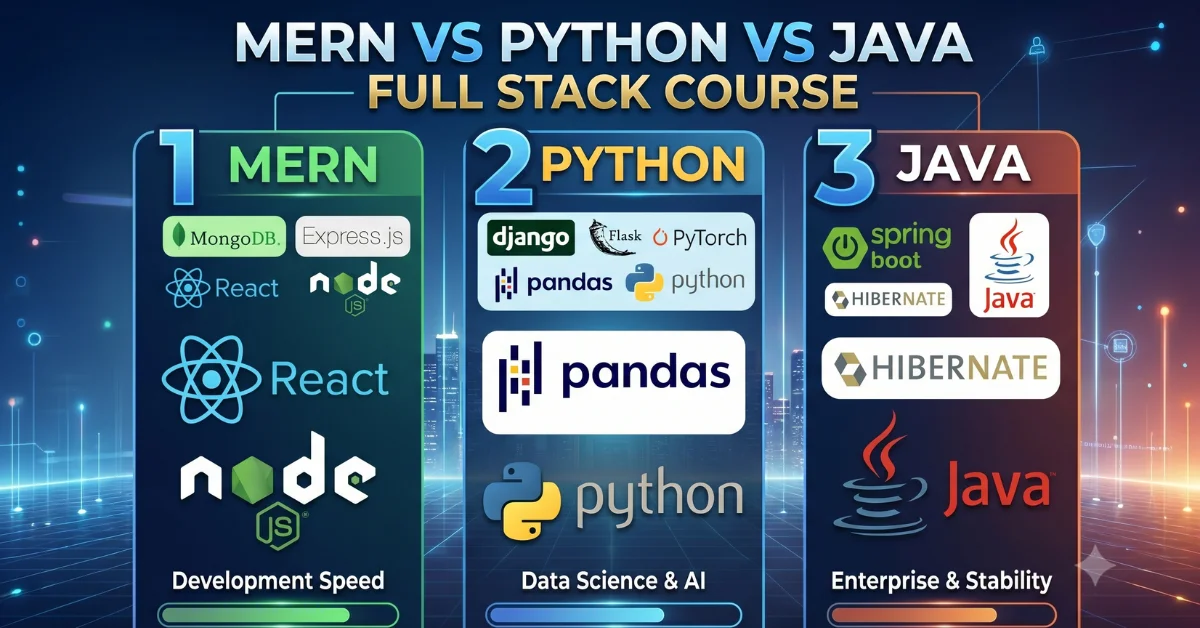
If you're searching for the best Full Stack Developer Course in Pune and wondering whether to choose a MERN Stack Course, Python Full Stack Course, or Java Full Stack Course, you're not alone. Thousands of engineering students, graduates, and career switchers face this decision every year. In 2026, all three technologies offer excellent career opportunities, but the right choice depends on your goals, learning style, and target job roles.
Here is the short answer before we go deep: there is no single "best" stack — there is a best stack for you. The best Full Stack Developer Course depends on your career goals.
- MERN Full Stack Development is one of the fastest paths into startups and product-based companies.
- Python Full Stack Development combines web development with opportunities in AI, Machine Learning, and automation.
- Java Full Stack Development is preferred by large enterprises, banks, and MNCs. All three offer strong job opportunities, salary growth, and placement potential in 2026.
All three technologies are in strong demand in 2026, and each can lead to a successful IT career when combined with practical training, real-world projects, and placement-focused learning. The right choice depends on your interests, educational background, and the type of software development career you want to build.
In this guide, we will break down each stack in detail, compare them side by side on the things that actually matter to a fresher — difficulty, job openings, salary, and long-term growth — and help you make a decision you won't regret six months into your course.
Quick Comparison: MERN vs Python Full Stack vs Java Full Stack
Before we go into detail, here is a snapshot comparison to orient you.
| Parameter | MERN Full Stack | Python Full Stack | Java Full Stack |
|---|---|---|---|
| Core Technologies | MongoDB, Express.js, React, Node.js | Python, Django/Flask, HTML, CSS, JavaScript | Core Java, Spring Boot, Hibernate, HTML, CSS, JavaScript |
| Learning Curve | Moderate (JavaScript everywhere helps) | Easiest for absolute beginners | Steeper (more boilerplate, strict syntax) |
| Best Suited For | Startups, product companies, fast-moving teams | Students who also want AI/ML/automation exposure | Students who prefer structure and plan to target enterprises, banks, MNCs |
| Primary Hiring Sectors | Startups, SaaS companies, product-based firms | IT services, AI/automation companies, startups, product firms | TCS, Infosys, Wipro, Capgemini, banks, insurance, large enterprises |
| Typical Fresher Salary Range (India, 2026) | ₹3.5–6 LPA, higher with strong React/Node projects | ₹3.5–6 LPA, with upside if combined with AI/automation skills | ₹3.5–6 LPA, often more consistent bulk hiring at this range |
| Career Crossover Potential | Frontend specialist, Node.js backend engineer | Data Analyst, AI/ML Engineer, Automation Engineer | Backend/Enterprise Architect, Microservices Engineer |
| Job Market Size in India | Very high in startup hubs (Pune, Bangalore, Hyderabad) | High and growing fastest due to AI demand | Consistently very high — largest fresher hiring volume historically |
| Long-Term Stability | Strong, tied to product company growth cycles | Strong, tied to AI/automation adoption | Very strong, enterprise IT rarely slows hiring |
This table gives you the broad strokes. Now let's understand why each of these stacks looks the way it does — because the "why" is what will help you make the right call for your own career.
What is MERN Full Stack Development?
MERN stands for MongoDB, Express.js, React, and Node.js — a JavaScript-based stack that lets you build the entire web application, frontend and backend, using one programming language. This is one of MERN's biggest advantages: instead of learning a separate language for the client side and the server side, you become proficient in JavaScript and use it everywhere.React, the frontend layer of MERN, is currently one of the most in-demand frontend libraries in the world, used by companies ranging from early-stage startups to giants like Meta and Netflix. Node.js, on the backend, is known for being fast, lightweight, and excellent at handling real-time applications such as chat apps, live dashboards, and streaming platforms. MongoDB, the database layer, is a NoSQL database that fits naturally with how modern web applications store flexible, fast-changing data. Because of this combination, MERN has become the default stack of choice for startups and product-based companies that need to build and iterate on applications quickly. If you enjoy building visually polished, interactive interfaces and want to work in a fast-paced, startup-style environment — possibly even freelancing or building your own SaaS product someday — MERN is an excellent fit.
Who should choose MERN: Students who enjoy front-end design and user experience, want to enter the startup ecosystem, are comfortable with a JavaScript-first mindset, and want to keep freelancing or remote international opportunities open, since the global demand for React and Node.js developers is exceptionally high.
If this sounds like you, you can start with our MERN Full Stack Web Development course, which covers MongoDB, Express, React, and Node.js through hands-on projects with placement support.
What is Python Full Stack Development?
Python Full Stack development typically combines Python (with frameworks like Django or Flask) on the backend with HTML, CSS, and JavaScript on the frontend. Python has consistently ranked as one of the most beginner-friendly programming languages because of its clean, readable syntax — which is exactly why it is often recommended to students with no prior coding background.What makes Python Full Stack particularly attractive in 2026 is its crossover potential. Python is not just a web development language — it is the dominant language in Artificial Intelligence, Machine Learning, Data Science, and automation. This means a student who learns Python Full Stack development isn't locking themselves into only web development; they are also building the foundation needed to later move into AI-powered roles, data analytics, or automation engineering without learning an entirely new language from scratch.
This dual relevance is becoming more important every year. As companies increasingly integrate AI tools and automated workflows into their products, having a Python-based skill set gives freshers a meaningful edge — many job descriptions in 2026 now explicitly mention "Python with exposure to AI tools" even for full stack roles.
Who should choose Python Full Stack: Students who want the gentlest learning curve, who are interested in keeping AI, automation, or data-related career paths open, and who may be coming from a non-IT or non-engineering background and want a language that doesn't punish them for not having a strong programming foundation yet.
If this matches your goals, explore our Python Full Stack Web Development course, designed to take you from fundamentals to job-ready, project-based skills.
What is Java Full Stack Development?
For freshers, this translates into a very practical advantage: enterprise IT companies hire in extremely large volumes, especially during campus placement seasons and bulk-hiring drives. If your goal is a stable, well-structured career path with predictable growth into roles like Senior Developer, Technical Lead, or Solutions Architect, Java Full Stack offers one of the most well-paved roads to get there.
Who should choose Java Full Stack: Students who prefer structured, rule-based learning over open-ended experimentation, who are aiming for large enterprises, MNCs, or government-adjacent IT companies, and who value long-term job stability and a clear, well-documented career ladder.
If enterprise-grade development appeals to you, check out our Java Full Stack Web Development course, covering Core Java, Spring Boot, and frontend essentials with real-time projects.
MERN vs Python vs Java: Key Differences That Actually Matter
Learning Curve and Time to Job-Readiness
If you are starting from zero, Python is generally the gentlest entry point — its syntax reads almost like plain English, which is why it's often the first language taught in Indian engineering and even school curricula. MERN comes next; once you understand JavaScript fundamentals, both the frontend (React) and backend (Node.js) feel like natural extensions of the same language, which shortens the overall learning curve even though there is more to cover conceptually. Java Full Stack typically takes the longest to feel comfortable in, simply because Java enforces stricter rules around object-oriented design, memory handling, and syntax — but students who push through this initial difficulty often find their fundamentals are stronger for it.Job Market Demand in India
All three stacks have strong demand in India in 2026, but the type of demand differs. MERN dominates in startup hubs like Pune, Bangalore, and Hyderabad, where product companies are racing to ship features quickly. Python Full Stack demand is rising fastest of the three, largely because companies want developers who can also contribute to AI and automation initiatives — a trend that is only accelerating. Java Full Stack continues to have the highest volume of fresher openings overall, because IT services giants and enterprise companies hire in bulk every single year, almost regardless of broader market conditions.Salary Potential for Freshers
At the fresher level, the difference in starting salary between the three stacks is usually smaller than students expect — most freshers across all three stacks start in a similar broad range, with the real differentiator being the strength of your projects, your internship experience, and your interview performance, not the stack itself. Where the stacks start to diverge is mid-career: MERN developers with strong product-company experience and Python developers who branch into AI/ML roles often see faster salary growth, while Java developers in enterprise environments tend to see steady, predictable increments tied to structured appraisal cycles.Career Growth and Long-Term Paths
This is where your choice has the most lasting impact. A MERN developer can grow into a Senior Frontend Engineer, Full Stack Architect, or even pivot into freelance/product development. A Python Full Stack developer has perhaps the widest range of pivot options — staying in web development, moving into Data Analytics, or transitioning into AI/ML engineering with comparatively less relearning. A Java Full Stack developer typically grows into Technical Lead, Enterprise Architect, or Engineering Manager roles within large organizations, with a well-defined hierarchy and growth path that many students find reassuring.Startup vs Enterprise Fit
If you can already picture yourself enjoying the unpredictability of a startup — frequent feature changes, smaller teams, more ownership — MERN or Python Full Stack will likely suit your temperament better. If you prefer working within established processes, clearer role definitions, and larger teams with formal documentation and review cycles, Java Full Stack's enterprise-heavy ecosystem will probably feel like a more natural fit.Which One Should You Choose? A Practical Decision Guide
Rather than telling you there's one "correct" answer, here is how to think about it based on common student profiles:Common Myths About Choosing a Stack (Busted)
"Java is outdated and only for legacy systems." This isn't accurate. Java continues to power some of the most modern enterprise systems in the world, and Spring Boot is actively maintained and widely used for building new microservices-based applications today, not just maintaining old code.
"MERN is only useful for startups, not stable careers." Many established product companies — not just early-stage startups — run on MERN or similar JavaScript stacks, and skilled MERN developers are hired by mid-size and large product companies as well, not exclusively two-person startups.
"Python isn't a 'real' full stack language for web development." Django, in particular, powers large-scale production applications and is a mature, battle-tested framework. Python's simplicity doesn't make it any less capable for building robust, production-grade web applications.
"Whichever stack has the highest fresher salary today is the best choice." Fresher salary differences between stacks are usually minor compared to the difference a strong project portfolio and good interview preparation makes. Choosing a stack you'll actually enjoy learning — and therefore practice consistently — almost always pays off more than chasing a marginally higher average salary number.
Final Verdict
There genuinely isn't a universally "best" stack among MERN, Python Full Stack, and Java Full Stack in 2026 — each one opens a different door. MERN is your fastest route into the startup and product-company world. Python Full Stack keeps your options open across web development, AI, and automation. Java Full Stack offers the most stable, high-volume path into enterprise IT.Frequently Asked Questions
Which is better for freshers in India in 2026 — MERN or Java Full Stack?
Neither is universally "better." MERN tends to suit students targeting startups and product companies, while Java Full Stack suits students targeting large enterprises and IT services companies that hire freshers in bulk. Both offer strong, comparable starting opportunities for a well-trained fresher.
Is Python Full Stack a good choice if I also want to get into AI later?
Yes. Python is the dominant language in AI, Machine Learning, and Data Science, so learning Python Full Stack development gives you a natural path to later specialize in AI-related roles without having to learn a new core language.
Which stack pays more, MERN, Python, or Java Full Stack?
At the fresher level, starting salaries across all three stacks are generally comparable and depend more on your project quality and interview performance than the stack itself. Salary differences become more visible only at the mid-to-senior level, based on the specific role and company.
How long does it take to become job-ready in MERN, Python, or Java Full Stack?
With consistent, focused learning, most students can become job-ready in any of the three stacks within 4 to 6 months through a structured, project-based course — though Java Full Stack often requires slightly more time to build strong fundamentals due to its stricter syntax.
Can a non-IT background student learn Java Full Stack?
Yes, but it generally requires more patience and practice compared to Python, since Java has a steeper learning curve. Many non-IT students do successfully transition into Java Full Stack roles with structured, mentor-led training.
Which stack has the most job openings in Pune in 2026?
All three have strong demand in Pune. MERN and Python roles are especially common among Pune's growing startup and product-company ecosystem, while Java Full Stack continues to see high-volume hiring from IT services companies and enterprise clients with a presence in Pune.
Should I learn more than one stack?
It's better to master one stack thoroughly first and build strong projects in it before considering a second one. Trying to learn multiple stacks simultaneously as a beginner often leads to shallow knowledge of all of them rather than job-ready expertise in any one.