MERN Stack Course Syllabus – Week by Week Description
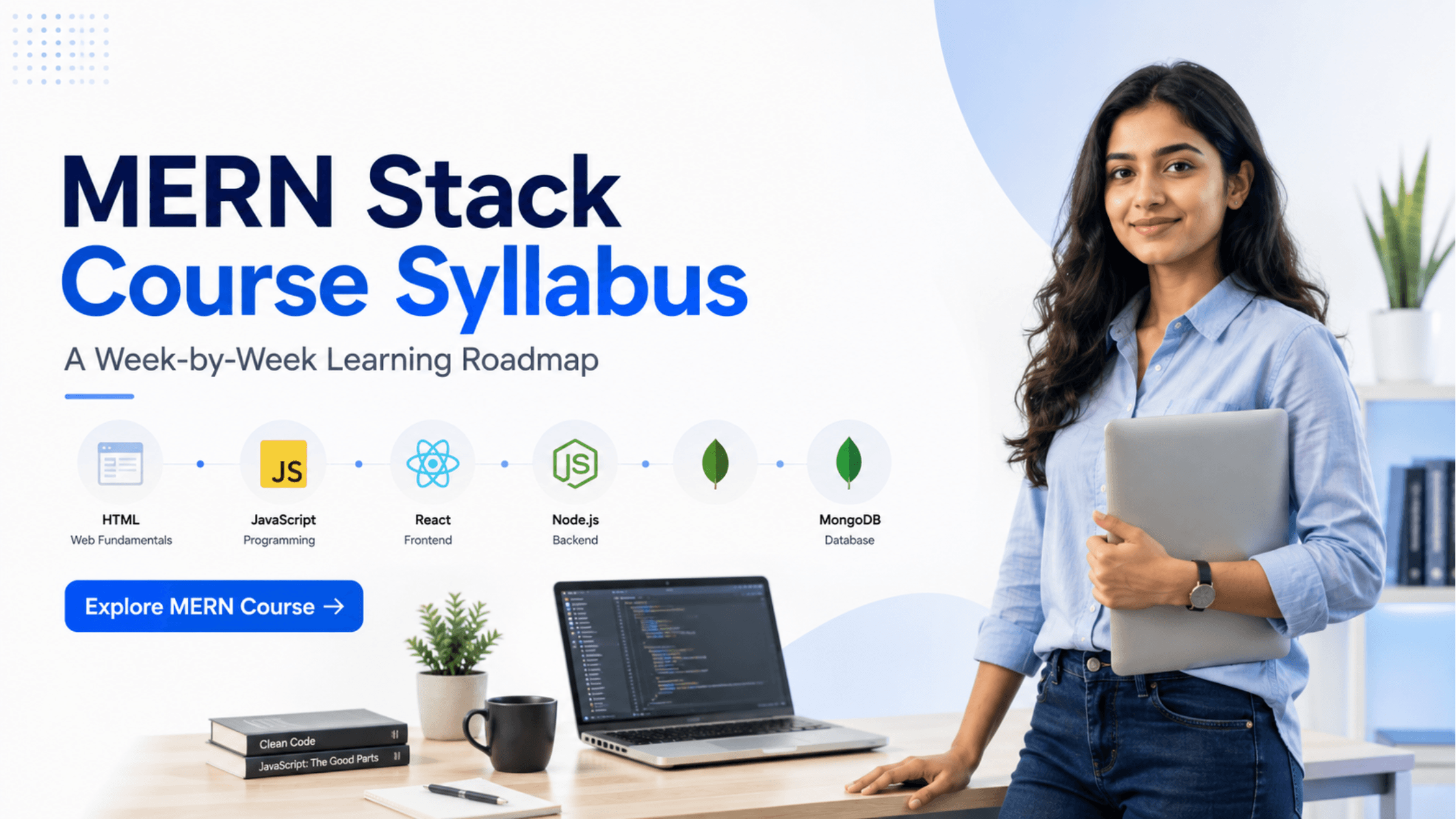
One of the first questions students ask before joining a MERN Stack course is simple: What exactly will I learn, and when will I be ready to build real applications?
A good full-stack curriculum should not jump directly into React or Node.js. It should gradually take you from web development fundamentals to JavaScript, frontend development, backend development, databases, complete applications, projects and interview preparation.
The following is a realistic week-by-week structure for a job-oriented MERN Stack web development course.
Quick Overview: MERN Stack Course Syllabus
| Stage | Weeks | Main Topics | Expected Outcome |
|---|---|---|---|
| Web Fundamentals | 1–2 | HTML, CSS, JavaScript basics, Git | Build a basic website |
| JavaScript | 3–5 | ES6+, DOM, APIs, async JavaScript | Build interactive applications |
| React.js | 6–7 | Components, props, state, routing, forms | Build frontend applications |
| Node.js & Express.js | 8–9 | APIs, routing, middleware, authentication | Build backend services |
| MongoDB | 10 | Database, Mongoose, CRUD | Work with application data |
| Full-Stack Development | 11–12 | Frontend + backend integration, deployment | Build complete applications |
| Projects & Interview Prep | 13+ | Projects, GitHub, coding and interviews | Build a job-ready portfolio |
The exact duration and modules can vary between institutions, but this progression gives students a useful framework for evaluating full stack web development courses.
Weeks 1-2: Web Fundamentals
Before diving into the MERN stack itself, any well-structured program should teach the basics of web development.
You'll typically learn:
- HTML5
- CSS3
- Responsive design basics
- JavaScript fundamentals such as variables, loops and functions
- Git and GitHub
At the end of this stage, you should be able to build a simple static website.
This foundation matters because everything that follows builds on these concepts. Whether you choose classroom training or an online MERN Stack development course, you should be comfortable with the basics before moving into frameworks.
Weeks 3-5: JavaScript
This is one of the most important stages because JavaScript forms the foundation for both the frontend and backend parts of the MERN ecosystem.
You'll learn:
- Variables, functions, loops and conditionals
- Arrays and objects
- Closures and prototypes
- ES6+ features such as arrow functions, destructuring and spread/rest
- Asynchronous JavaScript: callbacks, promises and async/await
- Working with the DOM
- Fetching data from APIs
After completing this stage, you should have a solid understanding of JavaScript and be ready to work with React and Node.js.
A common mistake is rushing through JavaScript to reach React faster. In practice, a strong JavaScript foundation makes learning the rest of the stack much easier.
Weeks 6-7: React.js
React is the frontend library used in the MERN stack.
During this stage, you'll learn the basics of building web applications with React:
- Components and JSX
- Props
- State and effects
- Conditional rendering and lists
- React Router
- Forms and inputs
- Connecting applications to APIs
At the end of this stage, you should be able to build simple interactive frontend applications.
For students comparing a MERN full stack development course, it is worth checking whether React training goes beyond basic component creation and includes API integration, routing and practical application development.
Weeks 8-9: Node.js and Express.js
Once you understand frontend development, the next step is learning how the backend works.
During this stage, you'll learn:
- Node.js fundamentals
- Building APIs with Express.js
- Routing and middleware
- Authentication and authorization
- Connecting applications to a database
At the end of this stage, you should understand how frontend applications communicate with backend services and be able to build simple server-side applications.
This is an important transition from frontend development to complete full-stack application development.
Week 10: MongoDB
MongoDB is the database component of the MERN stack.
During this stage, you'll learn:
- NoSQL and MongoDB basics
- Creating database schemas with Mongoose
- CRUD operations
- Relationships between data
- Querying and indexing
At the end of this stage, you should understand how application data is stored, retrieved and updated using MongoDB.
A practical MERN Stack course should connect database concepts with the applications students have already been building rather than teaching MongoDB only as a separate theoretical module.
Weeks 11-12: Full-Stack Development
This is where the individual technologies come together.
During this stage, you'll learn how to build end-to-end applications using the MERN stack:
- Connecting the frontend to the backend
- State management
- Working with APIs
- Deploying applications to production
- Basic security practices
At the end of this stage, you should be able to build a complete full-stack web application.
The goal isn't simply to know four technologies separately. The real value of MERN development comes from understanding how the frontend, backend and database communicate with one another.
Weeks 13+: Projects and Interview Preparation
Technology modules alone don't make someone job-ready.
Most job-oriented programs therefore include a project and interview preparation stage where students can apply what they've learned.
This may include:
- Real-world project development
- GitHub portfolio development
- Code reviews
- Debugging and problem-solving
- Technical interview preparation
- Resume preparation
- Mock interviews
A project should ideally demonstrate more than a basic tutorial. Students should be able to explain how their application works, why they selected particular technologies and how they handled common development challenges.
For freshers, this project experience can become one of the most useful talking points during technical interviews.
What Should a Good MERN Stack Course Include?
The exact syllabus varies from one institute to another, but a comprehensive program should generally cover:
Frontend: HTML, CSS, JavaScript and React.js
Backend: Node.js and Express.js
Database: MongoDB and Mongoose
Development tools: Git and GitHub
Application development: REST APIs, authentication and frontend-backend integration
Practical skills: Projects, deployment and debugging
Career preparation: Portfolio development, resume preparation and interview practice
If you're comparing fullstack classes in Pune, don't judge a program only by the number of technologies listed on the brochure. Look at how deeply each technology is taught and, more importantly, whether you get opportunities to apply those concepts.
What About a MERN Stack Course With Placement?
Students looking for a MERN Stack course with placement should evaluate the placement component separately from the technical syllabus.
Ask questions such as:
- Is interview preparation included?
- Are mock technical and HR interviews conducted?
- Will students receive project and resume guidance?
- Is there internship support?
- Does the institute have an active hiring network?
- What happens after course completion?
At Wisdom Sprouts, the MERN learning journey is designed around practical development as well as career preparation. Students can explore the curriculum, project work and placement-focused support before deciding whether the program matches their goals.
The important thing is to understand exactly what "placement support" means rather than choosing a course based only on the phrase.
How Long Does It Take to Learn MERN Stack?
There is no single duration that works for every student.
The core technology sequence can be structured across approximately 12 weeks, followed by projects and interview preparation. However, your actual learning time depends on your previous programming experience, practice outside class and the depth of projects you complete.
Someone who watches classes without building anything will progress very differently from a student who regularly writes code, debugs applications and builds projects.
Final Takeaway
A good MERN curriculum should follow a logical progression:
Web fundamentals → JavaScript → React → Node.js & Express → MongoDB → Full-stack applications → Projects → Interview preparation
The goal should not be to finish a list of technologies as quickly as possible. It should be to understand how those technologies work together to build real web applications.
If you're evaluating a MERN Stack course in Pune, use the syllabus as a starting point, but also compare trainer experience, project depth, internship opportunities, career support and the amount of practical coding included.
For students exploring MERN training in Pune, Wisdom Sprouts offers a structured learning path designed to take students from fundamentals through full-stack development and career preparation.